
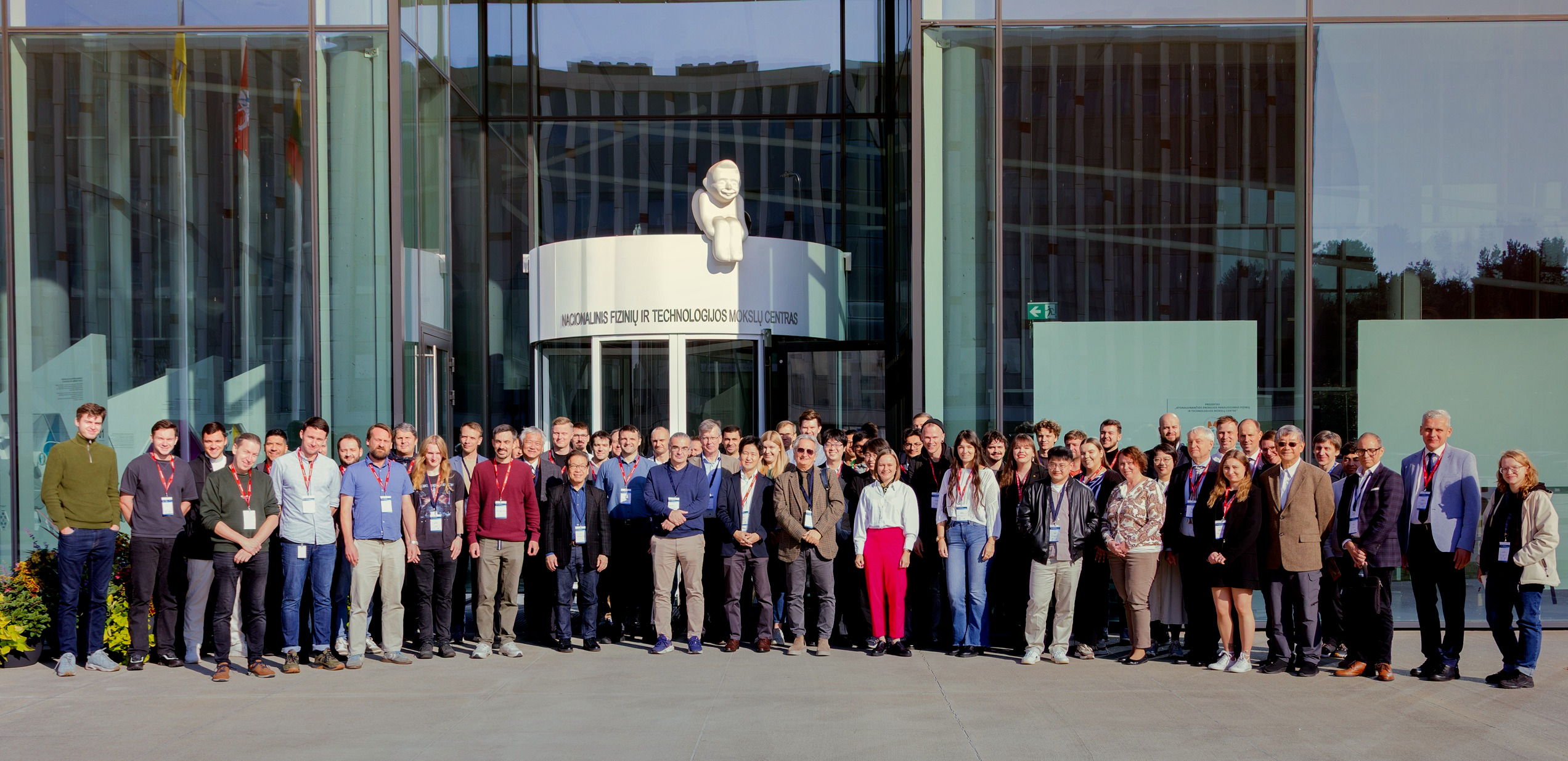
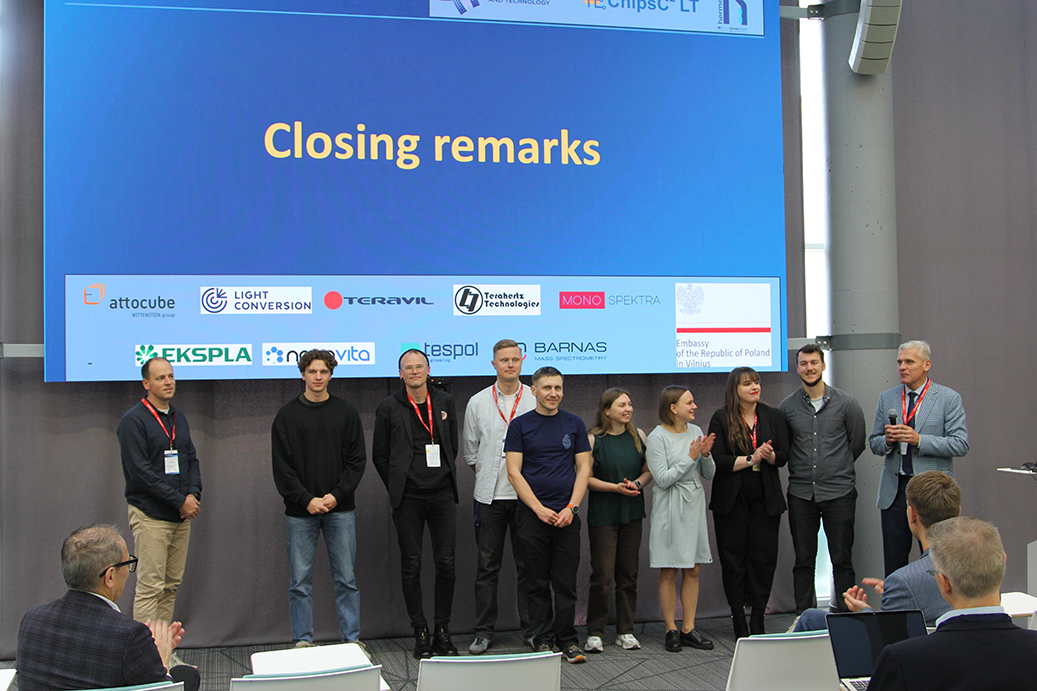
The 20th APROPOS conference (the 5th under the new name) continues a series of symposia held in Vilnius since 1971, which began as “Plasma and instabilities in semiconductors” and later became “Ultrafast Phenomena in Semiconductors” (UFPS). The conference aims to reveal and share new ideas in technology, research, and applications of advanced optoelectronic materials, to discover modern trends in optoelectronics research, and to discuss processes and fascinating phenomena arising when optics meets electronics.
Main topics include Semiconductor Nanostructures, Ultrafast and THz Phenomena, Advanced Photonics Systems, Nano- and Biophotonics, Organic Materials for Optoelectronics. One day before the conference, we are organising a free-of-charge tutorial session. During the conference, we will also invite you to participate in a special Lublin Readings session.
Lublin Readings
This is a special session with invited lectures dedicated to Lithuanian-Polish scientific cooperation. It also includes a traditional invited historical lecture on the most important events and heritage of the Polish–Lithuanian Commonwealth and beyond.
This year, we are going to take a deeper dive into Memory Politics, Symbolic Geography, and Competitive Claims to the 19th-Century City, asking a key question: “Whose Vilnius?“
After the session, we invite you to further explore the history of Vilnius by listening to the stories of the Central Vilnius University Ensemble and its historical Astronomical Observatory.
Special tutorial session
29th of September
Students and young researchers are invited to participate in the special tutorial session coorganized together with the International Young Scientists’ Symposium
Program:
Photonic-electronic heterogeneous integration technologies by Prof. Viktor Krozer
Optoelectronics that work above the cut-off frequency by Prof. Alvydas Lisauskas
Integrated Photonic Circuits: Enabling a New Era of Photonics by Dr. Armandas Balčytis
Seeing light up close: Near-field Optical Microscopy by Dr. Vladimir Zenin
Invited speakers
Prof. Xi-Cheng Zhang
University of Rochester, New York, USA
Prof. Xi-Cheng Zhang is a leading figure in terahertz photonics and optics, serving as the Parker Givens Chair at the University of Rochester’s Institute of Optics. Zhang conducted pioneering research in groundbreaking terahertz research during two decades at Rensselaer Polytechnic Institute, where he founded the Center for THz Research and pioneered ultrafast laser-based THz techniques. Zhang’s work advanced free-space terahertz optoelectronics and demonstrated novel uses for ultrafast “T-ray” pulses in imaging and spectroscopy. Since 2012 in Rochester, Professor Zhang’s group has continued to push the frontiers of terahertz science, developing advanced THz sources and detection techniques for spectroscopy and non-destructive imaging. Zhang has earned broad recognition as a Fellow of the AAAS, APS, IEEE, Optica, and SPIE, with major awards such as Optica’s William F. Meggers Award (2012) and the IRMMW-THz Kenneth J. Button Prize (2014) acknowledging pioneering contributions to terahertz science.


Prof. Heinz-Wilhelm Hübers
DLR & Humboldt University Berlin, Germany
Prof. Heinz-Wilhelm Hübers received a diploma and a Doctoral degree in physics from the University of Bonn, Germany, in 1991 and 1994, respectively. From 1991 to 1994, he was with the Max-Planck Institute for Radioastronomy, Bonn, Germany. In 1994, he joined the Deutsches Zentrum für Luft- und Raumfahrt (German Aerospace Centre, DLR), Berlin, Germany, becoming the Head of Department in 2001. From 2009 to 2014, he was a Professor of Experimental Physics at the Technical University of Berlin, Germany, and the Head of the Department “Experimental Planetary Physics” at the DLR-Institute of Planetary Research. In 2014, he became the Director of the DLR-Institute of Optical Sensor Systems and Professor in Physics at the Humboldt University of Berlin, Germany. In 2025, he was appointed Director of the DLR Institute of Space Research. His research interests are optical systems for space applications, in particular THz systems for astronomy, planetary research, and security. Prof. Hübers is the Track Editor of the IEEE Transactions on THz Science and Technology. He is the principal investigator (PI) and Co-PI of several airborne and spaceborne missions. He was the recipient of the Innovation Award on Synchrotron Radiation in 2003 and the Lilienthal Award in 2007. In 2021, he received an honorary doctorate at Chalmers University of Technology, Gothenburg, Sweden.
Prof. Miriam Serena Vitiello
CNR-NANOTEC, Pisa, Italy
Prof. Miriam Serena Vitiello is a senior researcher at the National Research Council of Italy (CNR-NANOTEC, Pisa), internationally recognised for her contributions to terahertz photonics and nanoelectronics. Her research focuses on the development of compact terahertz sources and detectors based on semiconductor and quantum devices, including quantum cascade lasers, as well as hybrid plasmonic architectures. By combining nanofabrication, spectroscopy, and device physics, Vitiello has advanced terahertz technologies relevant to spectroscopy, sensing, and imaging. Her work has been supported by major competitive funding programs, including European Research Council grants, and has helped shape the landscape of modern terahertz science.

Prof. Dr. Gintaras Valušis
Vilnius University, Lithuania
Prof. habil. dr. Gintaras Valušis is a prominent physicist and the Prorector for Research and Vice-Rector at Vilnius University. Before stepping into university leadership in 2025, he spent over a decade as Director of the Centre for Physical Sciences and Technology (FTMC). During his tenure, he was a key figure in establishing the “Saulėtekis” valley, effectively evolving the centre into a modern research foundry that connects semiconductor physics with industrial production.
On the scientific front, his work is centred on terahertz (THz) physics and semiconductor optoelectronics. He has led significant research into compact THz imaging and room-temperature detection, moving these technologies from theoretical models toward practical applications in diagnostics and security. A member of the Lithuanian Academy of Sciences and a recipient of the Lithuanian Science Prize, he has also held leadership roles within European research organizations like EARTO, focusing on the integration of Baltic science into the wider international community.
Prof. Taiichi Otsuji
ENSEMBLE3 Center of Excellence Ltd.
& Institute of High Pressure Physics, PAS, Poland
Prof. Taiichi Otsuji is the Professor, Group Leader, at the Photonic Elements Group, ENSEMBLE3 Center of Excellence sp. z o.o. (a non-profit research institution in the style of a limited liability company), Warsaw, Poland, under an unlimited, full-time employment condition. He is also a Professor at the Terahertz Laboratory, Institute of High Pressure Physics (UNIPRESS) of the Polish Academy of Sciences, Warsaw, Poland, since July 2026 under part-time employment conditions. He received the B.S. and M.S. degrees in electronic engineering from Kyushu Institute of Technology, Fukuoka, Japan, in 1982 and 1984, respectively, and the Dr. Eng. degree in electronic engineering from Tokyo Institute of Technology, Tokyo, Japan, in 1994. From 1984 to 1999, he worked for NTT Laboratories, Kanagawa, Japan. In 1999, he joined Kyushu Institute of Technology as an associate professor, being a professor in 2002. He joined the Research Institute of Electrical Communication (RIEC), Tohoku University, Sendai, Japan, in 2005, and retired in March 2025, and has been an Emeritus Professor at Tohoku University, Japan, since April 2025. Since April 2025, he has been in the current affiliation. His current research interests include ultra-broadband nanophotonic and plasmonic materials/devices and their applications to visible, infrared, terahertz, and millimeter-wave frequencies. He has authored and co-authored 321 peer-reviewed international journal papers and 656 international conference proceedings, including 216 invited/plenary presentations, and holds 15 Japanese and 10 US patents. He is the recipient of the Outstanding Paper Award of the 1997 IEEE GaAs IC Symposium in 1998, Prizes for Science and Technology in the Research Category, the Commendation for Science and Technology by the MEXT, Japan, in 2019, and the 59th Achievement Award of the IEICE (Institute of Electronics, Information, and Communication Engineers), Japan, in 2022. He has served as an IEEE Electron Device Society Distinguished Lecturer since 2013 and an IEICE Electronics Society Distinguished Lecturer since 2024. He is a Life Fellow of the IEEE (Institute of Electrical and Electronics Engineers), Fellow of the OPTICA (former OSA, Optical Society of America), JSAP (Japan Society of Applied Physics), and IEICE (Institute of Electronics, Information, and Communication Engineers, Japan), and a member of the MRS (Materials Research Society) and SPIE (International Society for Optical Engineering).


Prof. Willie Padilla
Duke University, North Carolina, USA
Prof. Willie Padilla is a leading expert in metamaterials and applied physics and a distinguished professor at Duke University. His doctoral research at UC San Diego (Ph.D. 2004) contributed to early experimental breakthroughs in metamaterials – Padilla was part of the team that demonstrated the first negative-index metamaterial, a revolutionary concept enabling artificial “left-handed” optical materials. Padilla has since pioneered a range of dynamic and functional metasurfaces, from actively tunable THz devices to metamaterial absorbers that achieve near-unity absorption under designed operating conditions of incident radiation. Padilla’s innovative approach to imaging led to the creation of single-pixel terahertz cameras using compressive sensing, drastically reducing the detector arrays required for THz imaging. He has received top honors, including the U.S. Presidential Early Career Award for Scientists and Engineers in 2009, and is recognised as a Fellow of the Optical Society (Optica) and of IEEE for his contributions to photonics and metamaterials.
Prof. Tadao Nagatsuma
Osaka University & The University of Tokyo, Japan
Prof. Tadao Nagatsuma received a Ph.D. degree in electronic engineering from Kyushu University, Fukuoka, Japan, in 1986. From 1986 to 2007, he was with Nippon Telegraph and Telephone Corporation, NTT, Kanagawa, Japan. From 2007 to 2024, he was a Professor of the Graduate School of Engineering Science and the Institute of Scientific and Industrial Research at Osaka University. He is a Professor Emeritus of Osaka University and is now with the Institute for Photon Science and Technology of the Graduate School of Science at the University of Tokyo.
His research interests include millimeter-wave and terahertz photonics and their applications to wireless communications, sensing, and measurement. He is a Life Fellow of the IEEE and a Fellow, Honorary Member of the Institute of Electronics, Information and Communication Engineers, IEICE, Japan. He serves as the President of the Terahertz Systems Consortium, Japan, and Past Vice President of the IEICE.

Prof. Kuniaki Konishi
University of Tokyo, Japan
Kuniaki Konishi received his B.S. (2001), M.S. (2003), and Ph.D. (2008) degrees from the Department of Applied Physics, the University of Tokyo. From 2003 to 2005, he worked as a Researcher at NTT Photonics Laboratories, Nippon Telegraph and Telephone Corporation. From 2008 to 2014, he was a Project Assistant Professor at the Photon Science Center, the University of Tokyo. From 2014 to 2021, he was an Assistant Professor at the Institute for Photon Science and Technology, the University of Tokyo. Since 2021, he has been an Associate Professor at the same institute. His main research interests are metamaterials, laser processing, and terahertz spectroscopy.
Prof. Polina Kuzhir
University of Eastern Finland, Finland
Prof. Polina Kuzhir is a Professor at the Institute of Photonics, University of Eastern Finland, and an internationally recognised expert in the electromagnetics of carbon nanostructures and theoretical and experimental photonics, with a current focus on biosensors. Her research spans 2D materials, graphene, and nanocarbon-based devices, with a particular focus on terahertz (THz) technology and biophotonics. A leader of numerous high-impact European initiatives, she has authored over 330 peer-reviewed papers in the field of nanomaterials.


Dr. Timo Aalto
VTT Technical Research Centre of Finland, Finland
Dr. Timo Aalto leads the Silicon Photonics research team at VTT and the development of monolithic PIC technologies in the PIXEurope pilot line. His own research focuses on the micron-scale silicon waveguides that are used to make ultra-compact and low-loss photonic integrated circuits for communication, imaging and sensing applications at near and mid infrared wavelengths.
As one of the first pioneers in silicon photonics, Aalto has contributed to over 130 scientific publications, reviewed several EU projects, journal articles and theses, and coordinated large projects funded by EU, the European space agency, national funding organisations and the industry. Aalto received his D.Sc. (tech) degree in optoelectronics technology from the Helsinki University of Technology in 2004 and has worked in Silicon photonics research at VTT since 1997.
Prof. Koichiro Tanaka
RIKEN Centre for Advanced Photonics & Kyoto University, Japan
Prof. Koichiro Tanaka is a leading expert in terahertz (THz) and ultrafast nonlinear spectroscopy. Since 2025, he has served as the Director of the RIKEN Centre for Advanced Photonics (RAP), while maintaining an adjunct professorship at Kyoto University. He earned his B.Sc. (1985), M.Sc. (1987), and D.Sc. (1990) degrees from Kyoto University. His career began as a Research Associate at the Institute for Solid State Physics, the University of Tokyo, in 1990. Following his work with the ERATO ‘Hirao Active Glass Project’ starting in 1995, he returned to the Department of Physics at Kyoto University as an Associate Professor in 1997 and was promoted to Full Professor in 2004. He also served as the Dean of the Faculty of Science at Kyoto University from 2023 to 2025.
Professor Tanaka’s research focuses on the fundamental physics of linear and nonlinear spectroscopy in the infrared and THz regions. He has pioneered several novel methods, including THz-ATR spectroscopy and high harmonic generation in solids. His significant contributions to the field were recognised with the prestigious Nishina Memorial Prize in 2018.

Dr. Antonio Maffucci
University of Cassino and Southern Lazio & EUT+, Italy
Antonio Maffucci, PhD, is a full professor of Electrotechnics with the Department of Electrical and Information Engineering at the University of Cassino and Southern Lazio, Cassino, Italy. He is also with the Institute of Nanomaterials and Nanotechnologies of the European University of Technology, EUT+.
His research areas include computational electromagnetics, electromagnetic compatibility, nanoelectronics, and quantum circuits. He is the author of more than 200 technical papers in international journals, conference proceedings, and essays in books. He chairs the IEEE EPS Technical Committee on Electrical Design, Modeling and Simulation, and is a member of the IEEE Nanopackaging Council. He is the Principal Investigator of the EU-Horizon project HERMES.
Dr. Shang-Hua Yang
National Tsing Hua University, Taiwan
Dr. Shang-Hua Yang stands out in the terahertz research community for bridging theory and application, from fundamental plasmonic photonics to real-world wireless and imaging systems. At National Tsing Hua University, Yang has built a vibrant lab exploring ultrafast electro-optics and THz devices, and he is spearheading Taiwan’s efforts in terahertz technology as director of a dedicated terahertz research centre at NTHU. Yang’s innovations include new schemes for high-speed terahertz wireless links and non-invasive THz imaging, reflecting his group’s ability to push technology boundaries in both communications and sensing. Yang has garnered significant acclaim at a young age: major honours such as the Ta-You Wu Memorial Award (2024) and the NTHU Young Faculty Research Award (2020) highlight the impact of his early-career achievements. Yang, a Senior Member of IEEE and a Member of Optica and SPIE, contributes to the scientific community beyond research by serving on organising and technical program committees for leading optics and electromagnetics conferences.


Dr. Linas Minkevičius
Centre for Physical Sciences and Technology (FTMC), Lithuania
Dr. Linas Minkevičius received his doctorate degree in Semiconductor Physics in 2016 (Thesis: Terahertz Imaging Arrays for Room Temperature Operation), which was awarded as the best thesis of the year in the field of physics and technology. He currently leads the Optoelectronics Division and the Optoelectronic Systems Characterisation Laboratory and serves as a Chief Researcher at the Centre for Physical Sciences and Technology. He is also an alumnus of the Young Academy of the Lithuanian Academy of Sciences. He has been active in academia since 2012 at Vilnius University, where he currently serves as a professor teaching the Optoelectronics course. He supervises PhD candidates and undergraduate thesis students and is involved in numerous national and international collaborative research projects. His research focuses on cutting-edge developments in optoelectronics, particularly in advancing terahertz (THz) imaging systems. His current research aims to develop integrated optoelectronic THz imaging platforms. His work includes the design of room-temperature THz sensors, diffractive optics for the terahertz range, and THz wave manipulation using metasurfaces. He has more than 13 years of research experience in terahertz and infrared optoelectronics. His h-index is 18, with more than 1000 citations, reflecting the international impact of his scientific contributions.
Dr. Erik Waller
Fraunhofer ITWM, Germany
Dr. Erik Waller is a researcher in photonics and optical engineering affiliated with the Fraunhofer Institute for Industrial Mathematics in Kaiserslautern, Germany. He completed his doctoral studies at the Technische Universität Kaiserslautern (now part of RPTU Kaiserslautern-Landau), specialising in optical technologies and microfabrication.
His research focuses on advanced fabrication methods for photonic devices, particularly additive micro- and nano-manufacturing techniques such as multiphoton lithography. Using these approaches, he develops complex three-dimensional microstructures for applications in infrared and terahertz photonics.
Waller has contributed to the development of free-form optical components, waveguides, and metamaterial-inspired structures, as well as to experimental systems such as fiber-based probes for combined optical and terahertz signal delivery. His work supports the design of compact optical systems for sensing, imaging, and integrated photonic applications.


Prof. Georgy Fedorov
University of Eastern Finland, Finland
Dr. Georgy Fedorov obtained his PhD in Condensed Matter Physics from the Moscow Institute of Physics and Technology (MIPT) in 2002 and has since held research positions at several leading international institutions, including the National High Magnetic Field Laboratory (USA), Georgetown University (USA), and the Laboratoire National des Champs Magnétiques Pulsés (France).
His early research focused on the electronic and optical properties of semiconductor nanostructures and heterostructures. Over the past decade, his work has centered on THz photonics, beginning with studies of quasi-metallic carbon nanotubes (CNTs) as narrow-gap semiconductors using THz spectroscopy. He subsequently expanded his research to CNT- and graphene-based THz detectors and, more recently, to THz spectroscopy and imaging for biomedical applications.
Since 2022, Dr. Fedorov has been based in Finland. He is currently a Senior Researcher and Leader of the THz Photonics Group at the University of Eastern Finland, within the Department of Physics and Mathematics and the Centre for Photonics Sciences. His research focuses on THz photonics, nanomaterials, spectroscopy, imaging, and their applications in biomedical diagnostics and advanced sensing technologies.
Dr. Karolis Kazlauskas
Vilnius University, Lithuania
Dr. Karolis Kazlauskas is a leading figure in the field of organic semiconductor photonics, heading the Organic Optoelectronics Laboratory at Vilnius University’s Institute of Photonics and Nanotechnology. He has made seminal contributions to materials for organic light-emitting devices and stimulated-emission applications, designing novel molecular structures that exhibit efficient fluorescence and improve the operational stability of organic emitters. Kazlauskas’s group is also known for advancing photon upconversion techniques, enabling the conversion of low-energy infrared light into higher-energy visible emissions – an approach that has potential applications in areas like foldable displays and light-emitting fabrics. He has authored numerous highly cited papers in journals such as J. Mater. Chem. C and Adv. Optical Mater. and is frequently invited to present his work, including invited talks at major international workshops and conferences in Japan and elsewhere. Dr Kazlauskas’s contributions have earned him accolades such as the Lithuanian Academy of Sciences’ Young Scientist Fellowship and multiple Vilnius University awards for research excellence, cementing a reputation as a leader in optical materials research.


Dr. Ronald Ulbricht
Max-Planck Institute for Polymer Research, Germany
Dr. Ronald Ulbricht received his diploma in physics at TU Dresden, and subsequently began his doctoral studies at the FOM Institute AMOLF in Amsterdam, where he obtained his PhD in 2012 for his work on THz spectroscopy on semiconductors. He then embarked on a series of postdoctoral positions: as a JSPS fellow at Hokkaido University, Japan, working on picosecond photoacoustics; as a Rubicon fellow at the University of Colorado, Boulder, working with optical near-field scanning probe microscopy; and as a DFG fellow at Nanyang Technological University in Singapore, investigating the transient optical dynamics of nitrogen-vacancy centers in diamond. He is now a group leader in the Department of Molecular Spectroscopy of the Max-Planck Institute for Polymer Research in Mainz, Germany. The research group currently has a strong focus on utilizing time-resolved spectroscopy techniques to study color centers in wide-bandgap semiconductors.
Lublin Readings session
Prof. Agnieszka Siemion
Warsaw University of Technology, Poland
Prof. Agnieszka Siemion has pushed the frontiers of modern optics into the terahertz realm, crafting a niche where purely photonic phenomena intersect with millimetre-wave science. Prof. Siemion leads cutting-edge experiments at Warsaw University of Technology on THz diffractive optics, creating components like frequency-selective surfaces and multi-focus lenses that unlock new capabilities in the far-infrared spectrum.
Siemion’s experimental prowess has yielded novel THz imaging techniques – including systems capable of distinguishing minute differences in tissue composition – which hold promise for non-invasive medical diagnostics and security scanning.
She was actively involved with major research initiatives, including a LIDER project on terahertz systems for skin cancer research and an OPUS project investigating terahertz optical MIMO concepts. Beyond research, Siemion is celebrated for outstanding teaching – winning the student-bestowed Golden Chalk Award five times – and has taken on a key leadership role as Vice-Dean for Student Affairs (since 2020), helping foster the next generation of optical physicists.


Dr. Marcin Bialek
Institute of High Pressure Physics, PAS, Poland
Dr. Marcin Białek is a researcher at the Institute of High Pressure Physics of the Polish Academy of Sciences and a former postdoctoral fellow at EPFL, Switzerland. His research focuses on the intersection of terahertz (THz) optics and spintronics, specifically exploring the strong coupling between electromagnetic radiation and magnetic excitations. He is currently leading the PASIFIC project “TeraMag,” which investigates new methods for the electrical detection and manipulation of magnon-polariton states.
Dr. Rusnė Ivaškevičiūtė-Povilauskienė
Centre for Physical Sciences and Technology (FTMC), Vilnius
Dr. Rusnė Ivaškevičiūtė-Povilauskienė is a researcher in terahertz photonics at the Centre for Physical Sciences and Technology (FTMC). Her work centres on the development and application of terahertz imaging systems for the non-destructive investigation of objects and materials. She conducts research on innovative optical components designed for operation in the THz spectral range, including elements incorporating metamaterials. One of her current main research directions is digital THz holography, with a focus on advancing imaging and characterisation capabilities in the terahertz domain.


Dr. Darius Staliūnas (special guest)
Vilnius University, Lithuania
Dr. Darius Staliūnas is a Chief Researcher at the Lithuanian Institute of History and a member of the Lithuanian Academy of Sciences. A leading expert on 19th-century history, his research focuses on the Russian Empire’s nationality policies and the complex politics of memory within the former Grand Duchy of Lithuania. Having held visiting positions at institutions such as UC Berkeley and the Hebrew University of Jerusalem, he was awarded the Lithuanian Science Prize in 2016 for his contributions to the field.
At the APROPOS conference, Dr. Staliūnas will explore the shifting symbolic and geographical identities of 19th-century Vilnius. In his presentation, “Whose Vilnius? Memory Politics, Symbolic Geography, and Competitive Claims to the 19th-Century City,” he will examine how various cultural and political narratives intersected to shape the city’s identity. His talk will delve into the competing mental maps and historical claims that defined the urban landscape during a transformative era of imperial and national transition.
Tutorial session
Prof. Dr. Viktor Krozer
Ferdinand-Braun Institute for High-Frequency Electronics, Berlin, Germany
Prof. Dr.-Ing. Viktor Krozer is an internationally recognised expert in high-frequency electronics, photonic-electronic heterogeneous integration technologies, terahertz (THz) technology, and advanced sensing systems who leads the THz components and systems group at Ferdinand-Braun-Institut, Leibniz Institute for High Performance Microelectronics, Berlin. His research focuses on the development of semiconductor-based millimetre-wave and THz devices and systems, with applications ranging from spectroscopy and imaging to biomedical diagnostics and security screening. His research areas focus on terahertz electronics, MMIC design and characterisation, nonlinear circuit analysis and design, device modelling, and remote sensing instrumentation as well as imaging systems.
Prof. Alvydas Lisauskas
Vilnius University, Lithuania
Prof. Alvydas Lisauskas is a Lithuanian physicist and a professor at Vilnius University, known internationally for his contributions to terahertz (THz) electronics and imaging. He has a distinguished career in developing field-effect transistor (FET) based THz detectors and monolithic integrated circuits, exploring operation beyond conventional frequency limits.
Early in his career, Lisauskas collaborated with colleagues in Germany to demonstrate an early demonstration of all-silicon 0.65 THz camera systems using standard CMOS technology – a milestone achievement for cost-effective THz imaging. He leads research on plasma-wave electronics in high-speed transistors, enabling THz detection above the traditional cut-off frequency.
His contributions have been recognised with prestigious honours, including the Kazimieras Baršauskas Prize from the Lithuanian Academy of Sciences in 2022 for his work “Terahertz electronics: application of plasma waves in semiconductor devices above cutoff frequencies” and the IEEE MTT-S Terahertz Science and Technology Best Paper Award (2021) for innovations in THz FET detector technology.
Dr. Armandas Balčytis
Royal Melbourne Institute of Technology, Melbourne, Australia
Dr. Armandas Balčytis is a Lithuanian photonics researcher working at RMIT University in Melbourne, Australia. He received his Master’s degree in Materials Science and Semiconductor Physics from Vilnius University in 2013 and completed a joint PhD through a collaboration between Swinburne University of Technology and the Centre for Physical Sciences and Technology (FTMC) in Lithuania.
His research combines nanofabrication and photonics, with a focus on integrated photonic circuits, plasmonics, and ultrafast optical phenomena. He has contributed to research on photonic synthetic dimensions, including a 2024 study exploring dynamically modulated lithium niobate ring resonators for simulating higher-dimensional photonic lattices on a chip.
His work on metamaterials and nano-optical devices has been published in peer-reviewed journals and conference proceedings, and he collaborates with international research groups in Japan and Europe on the development of advanced on-chip photonic technologies.


Dr. Vladimir Zenin
Mads Clausen Institute (MCI), University of Southern Denmark, Denmark
Dr. Vladimir Zenin received his Ph.D. in Energy and Environmental Technologies from the University of Southern Denmark in 2014. Since the beginning of his Ph.D. project in the Nano Optics group, his academic work has been closely connected with scanning near-field optical microscopy (SNOM).
He first developed expertise in fiber-based collection-mode SNOM, using fiber probes fabricated in-house by HF etching. Later, the group acquired a scattering-type SNOM system, which opened new opportunities for a wide range of advanced nanoscale optical studies. This technique proved to be particularly robust and reliable, enabling highly accurate optical measurements at the microscale and nanoscale.
His work has culminated in the use of SNOM for precise measurements of optical constants in advanced materials, including synthesized gold monocrystals and exfoliated van der Waals flakes. Dr. Zenin has authored numerous papers in high-impact journals and is frequently invited to present his research at major international workshops and conferences.